
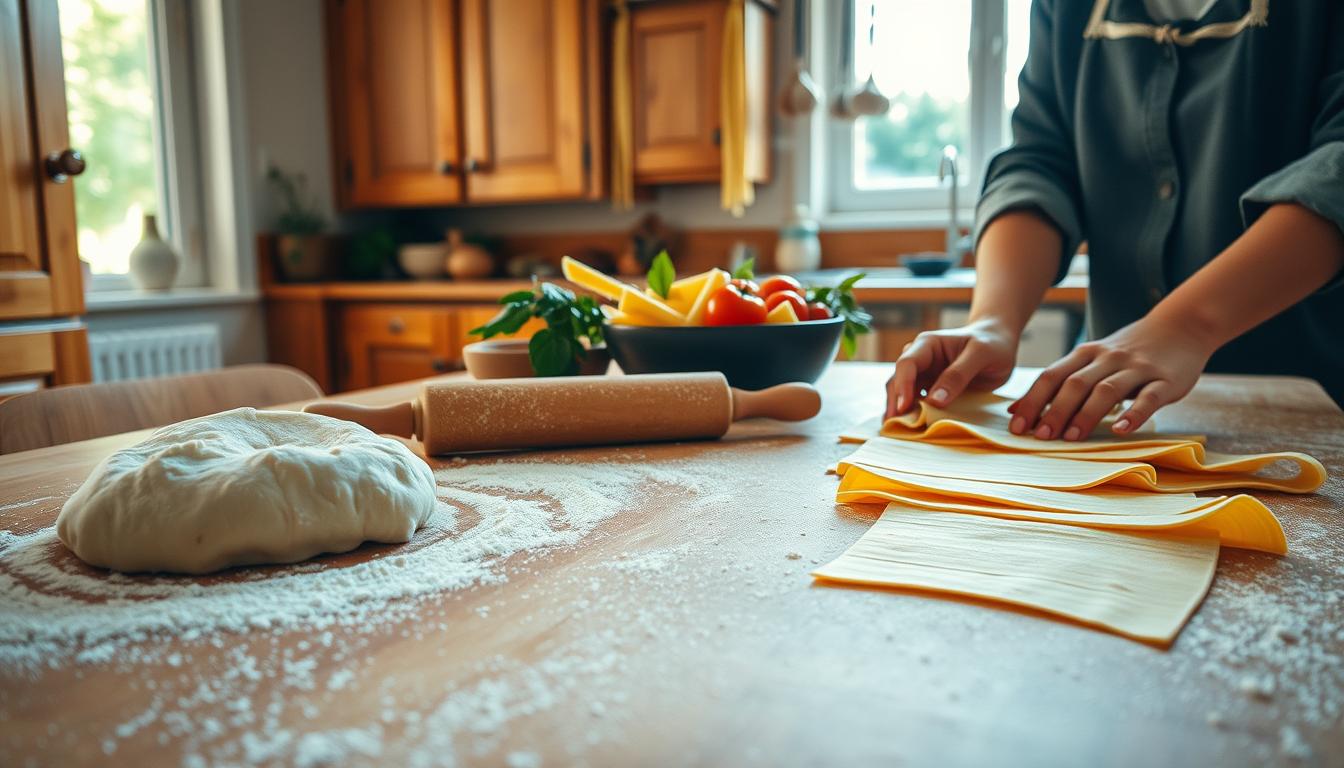
Homemade Pasta (No Machine Required)
Pasta made from scratch is often seen as a time-consuming and intimidating task, but that isn’t really the case. There’s no need to hassle with purchasing a pasta machine for this either.
In fact, all that is truly required is a rolling pin, some pantry items, and some free time (about an hour). After making fresh pasta, you will be disgusted by the thought of eating store-bought pasta ever again.
This article will describe how to make homemade pasta, no machine, step by step, beginner friendly, and easy enough to do on a weeknight.
The Joys of Making Pasta by Hand
Hand pasta rolling may take a decent amount of time, but the result is definitely worth it.
There is a level of pasta texture that can only be achieved through hand rolling the dough. With hand rolled pasta, you can feel when the dough is the right consistency (smooth, elastic, etc.). Because of this, there is nothing quite like the experience of fresh pasta.
Additionally, the dough requires quite a bit of kneading, making it oddly therapeutic.
What You’ll Need
Ingredients
Pasta is really only two base ingredients:
- Flour — Raised pasta flour in an ideal world would be Italian 00, however, semolina flour is perfect for rustic pasta. All-purpose flour works well for an everyday pasta flour.
- Eggs or water — Pasta that contains an egg dough is richer and more tender than pasta that is simply water and similarly more durable.
Basic ratio: 100g flour to 50–60g liquid
Tools
You don’t need fancy tools!
- Large wooden board or clean countertop — Wood grabs dough and is ideal when kneading.
- Long, thin wooden rolling pin — A wooden dowel gives great control over rolling thickness.
- Bench scraper — A great tool for mixing dough and cleaning your surface (~$8, totally worth it).
- Sharp Chef’s Knife — Good for cutting your pasta sheets.
- Digital Kitchen Scale — A flour-to-liquid ratio of 100g flour to 50–60g liquid calls for precision.
How to Make Pasta by Hand: Step-by-Step Guide
Making pasta by hand takes a little bit of practice, but is an excellent skill to master. Follow these steps to learn how to do this!
Step 1: The Flour Well
This step is simple.
Pour the flour onto the clean surface and form a mountain. Create a crater in the top of the mound to hold your eggs or water.
Step 2: Mixing the Dough
For this step, pour your eggs or water into the flour well.
Grab a fork and scrape the flour walls into the liquid. Continue to do this until all of the liquid is absorbed and the mixture is too thick to stir.
At this point, you can use your bench scraper to scrape the flour and do the final mixing.
It is now ready to form a ball.
Step 3: Kneading the Dough
Kneading dough is the most important step of all!
To get the correct consistency of the dough, use the heels of your hands to push the dough away and fold it back over itself.
Smooth and elastic dough will be ready after about 5 minutes of kneading.
If kneading dough becomes too dry, add water with your fingers.
If kneading dough becomes too sticky, add a dusting of flour.
Quick Fixes
| Problem | Likely Cause | Fix |
| Dough too dry | Too much flour or low humidity | Add water, ½ tsp at a time |
| Dough too sticky | High humidity or large eggs | Dust with flour, 1 tsp at a time |
| Dough tough or snapping back | Over-kneaded | Let it rest 10 extra minutes |
Step 4: Rest the Dough (Don’t Skip This!)
Wrap the dough in plastic wrap and let it rest at room temperature for 30 minutes or more.
This step is very important.
It relaxes the gluten, so the dough is much easier to roll out without snapping back.
If the rest is skipped, expect frustrations while rolling out the dough.
Step 5: Roll It Out
Flour your rolling pin and your work surface.
Place the dough in the center of the work surface and begin rolling toward the edges.
After each push of the rolling pin, turn the dough a quarter turn.
The goal here is to roll the dough out until it is translucent.
The dough resists?
Let it rest for a few minutes before continuing.
To prevent tearing, apply even, low pressure to the dough and keep the work surface lightly floured.
If a tear happens, pinch it back together and continue.
Step 6: Cut Your Pasta
To keep your pasta sheet from sticking, lightly dust the surface.
Then roll your sheet up into a loose scroll and slice it with a sharp knife.
- Fettuccine and tagliatelle are cut into quarter-inch strips.
- Pappardelle is cut into strips a whole inch wide.
- A pastry wheel can cut pasta into more rustic shapes with wavy edges.
Once separated, let the pasta rest.
Cooking Fresh Pasta
Fresh pasta cooks much faster than dried pasta, so stay right by the stove.
Boil a pot of salted water, then add your fresh pasta for 2–3 minutes.
It should be chewy and taste good with the water.
Once cooked, sauce and serve!
Sauce Pairing Tips
Light sauces like butter, olive oil, or a light cream sauce work well with thin noodles like fettuccine.
Pappardelle can handle heavier sauces like meat ragù or chunky mushroom ragù.
Storing Homemade Pasta
Did you end up with a lot of pasta? No worries, it stores well!
Short-Term Storage (1 to 2 Days)
Place cut noodles in a little semolina flour to absorb moisture and help prevent them from sticking.
Nest in small piles on a tray lined with parchment paper and refrigerate in an airtight container.
Long-Term Storage (Up to 1 Month)
Flash freeze nests for 30 minutes in the freezer, then place them in a freezer-safe bag, trying to get as much air out as possible.
When you’re ready to eat the pasta, don’t forget you can cook it from frozen.
Just add a minute or two to the usual cooking time.
Which Flour Should You Use?
Italian 00 Flour
Great for making delicate noodles like fettuccine or tagliatelle.
It is very fine and silky.
Semolina Flour
Great for rustic pasta shapes like cavatelli and orecchiette.
Coarser and more grainy than other flours.
All-Purpose Flour
Good for everyday pasta.
Ideal for beginners.
Final Thoughts
Making pasta from scratch is a great skill to learn because it sounds difficult but is easy to do once you get the hang of it.
The dough is very forgiving, and the process is very meditative and rewarding.
Fettuccine and tagliatelle are wonderful beginner shapes to use to learn the skill of pasta making.
There’s nothing better than serving someone a bowl of fresh, hand-made pasta!